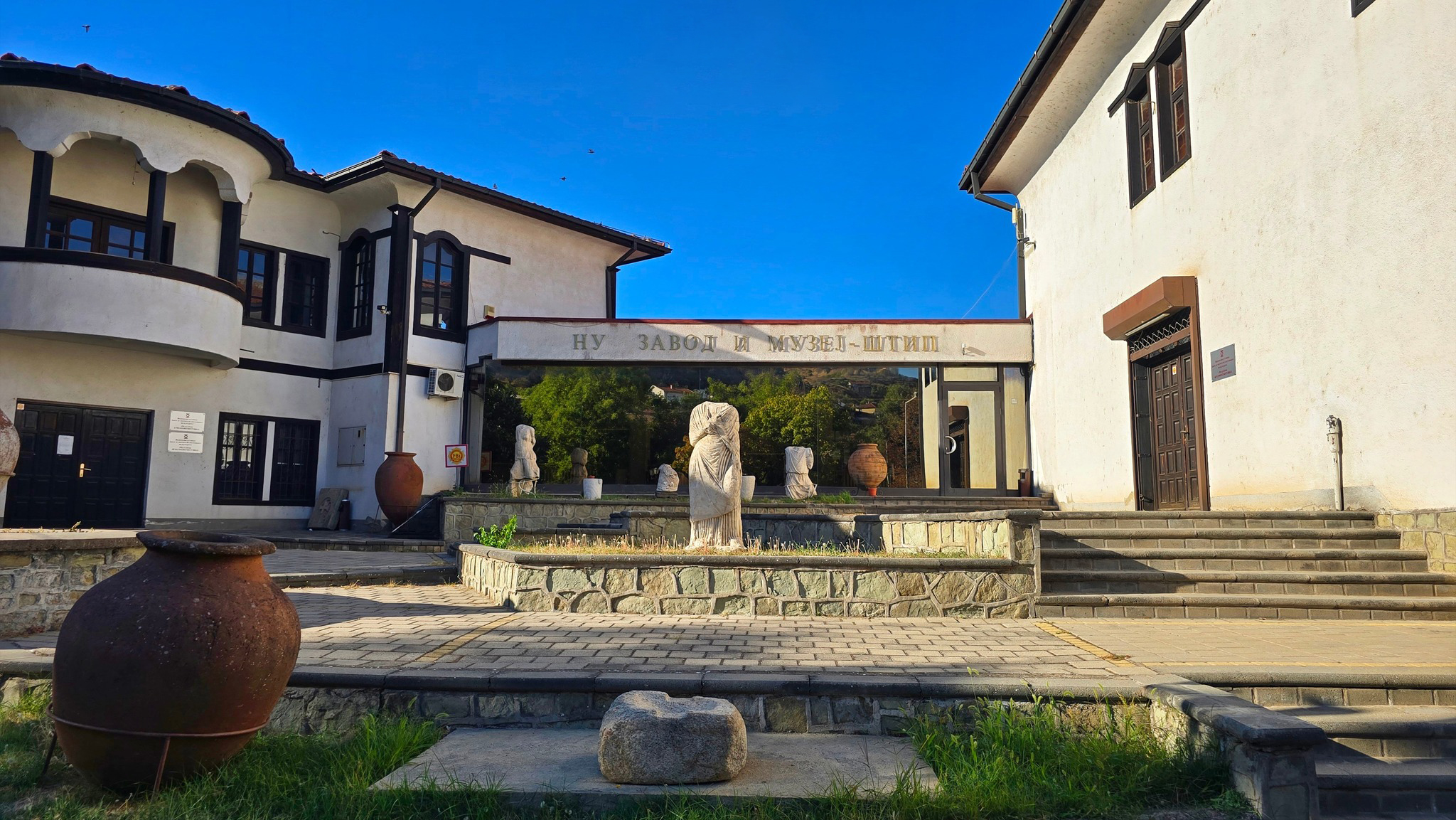
NI Institute and Museum Shtip
The museum in Shtip was established by a decision of the Municipal People’s Committee of the City of Shtip on 10 May 1950. The first museum exhibition was opened in 1956 in a house; however, due to its small size and ethnological character, on 11 October 1956 the museum was moved to the newly adapted building of the former Turkish architecture school, known as the House of the Arsovi family (formerly also referred to as the House of Ljubomir Arsov). In 1964, a permanent exhibition was opened, featuring the contemporary Macedonian fine arts collection in the Bezisten Art Gallery, which represents part of the museum. In 1972, on the initiative of Kosta Balabanov, a permanent icon gallery was opened in the 19th-century church “Uspenie na Presveta Bogorodica” in Novo Selo. In 1978, the museum building was renovated, and the museum premises were relocated to the old “Zdravsten Dom” building together with the entire staff and documentation. In 1979, the museum gained the status of an Institute for the Protection of Cultural Monuments and the People’s Museum, unlike its previous status as only the People’s Museum of the Shtip region. In 1985, the museum was returned to the House of the Arsovi family, which had been vacated in 1978 for the purpose of renovation. Since then, the museum exhibitions have functioned continuously to this day.
In 1980, a project was prepared to expand the museum with an additional building, using the former house of the Anevci–Gochevi family, where the archaeological exhibition is now located. Between the House of the Arsovi family and the Anevci–Gochevi house, an administrative building was also planned, where the administrative department would be housed. This project was completed in 2004. Today, the museum complex consists of three buildings—one administrative, and the other two exhibition buildings.
Within the Institute and Museum of the City of Shtip also operate the Museum of VMRO for Shtip and the Shtip region (1893–1934), opened in 2014, the Bezisten Art Gallery, and the Memorial House of Slavcho Stojmenski.