Official name: Church “Uspenie na Sv. Bogorodica” with residential quarters, ul. “Krste Misirkov” 6.6, Novo Selo, Shtip
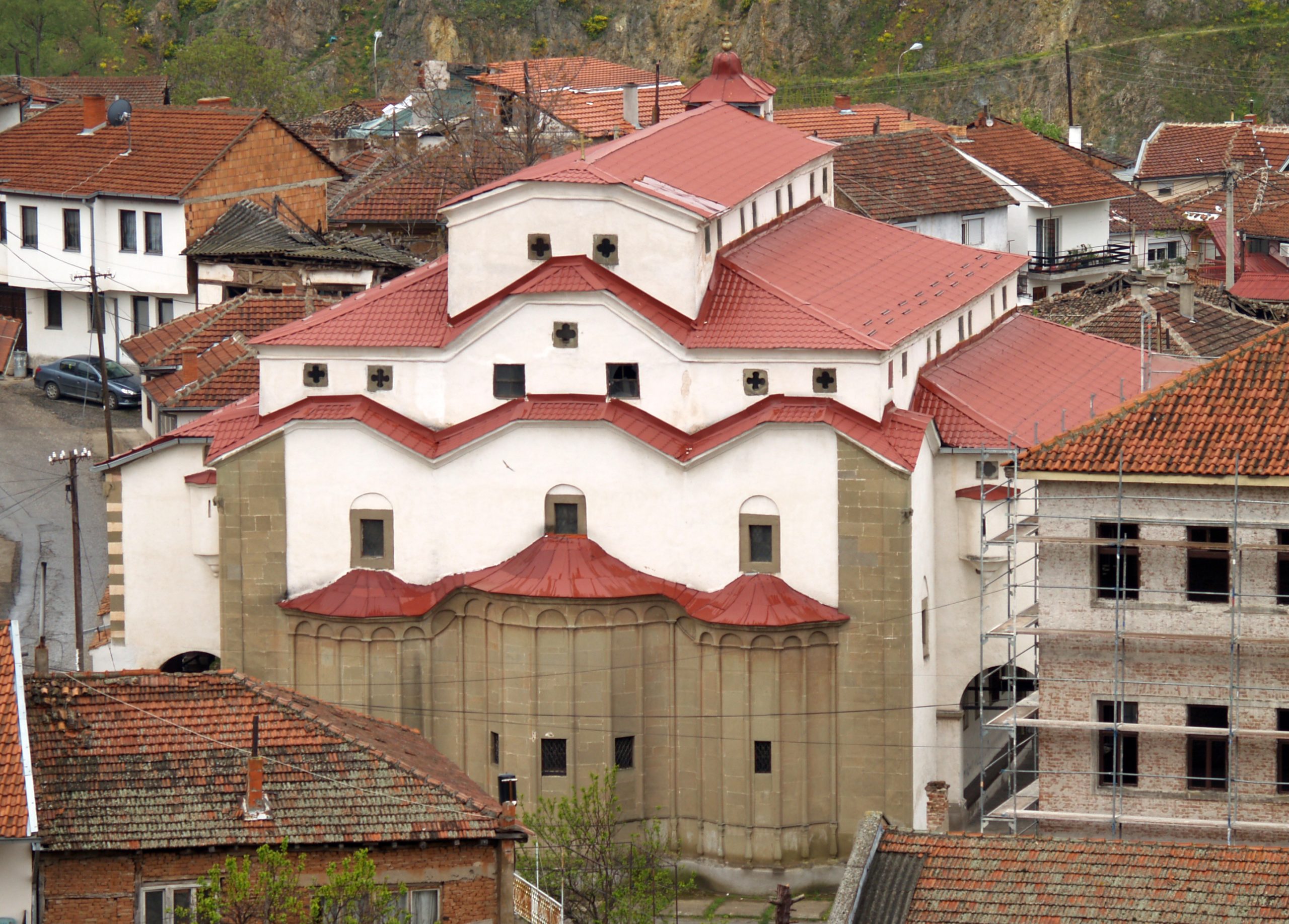
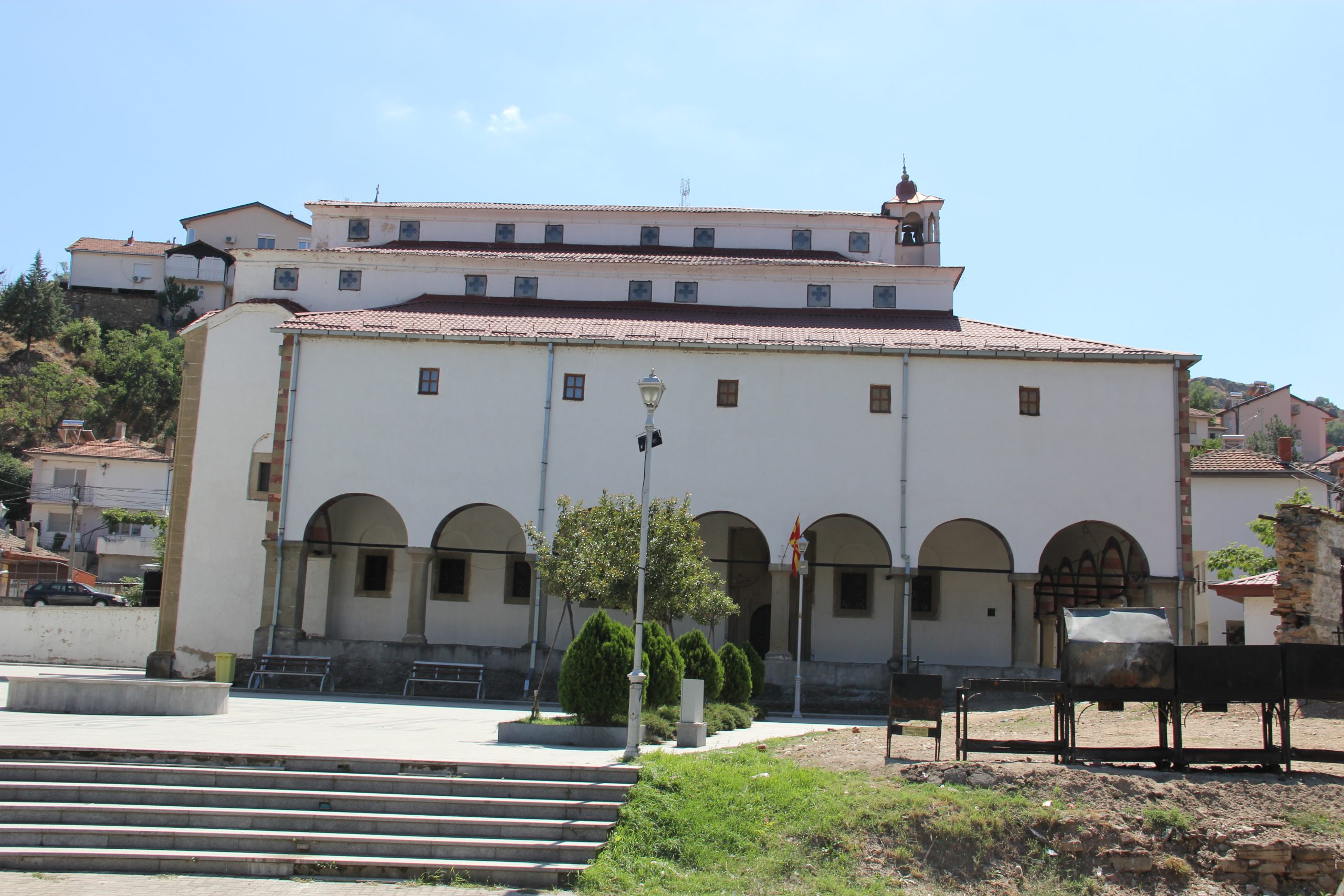
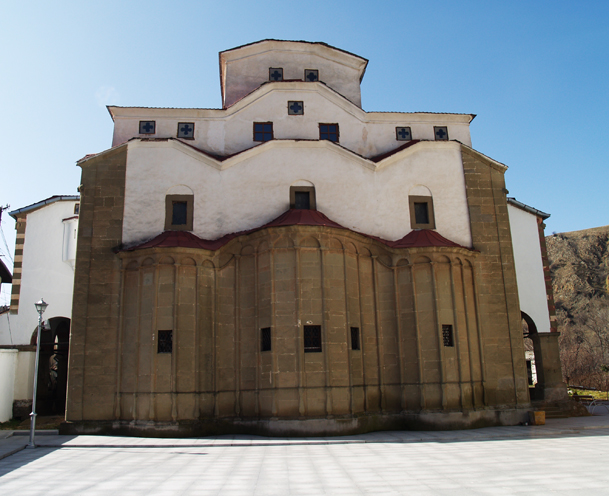
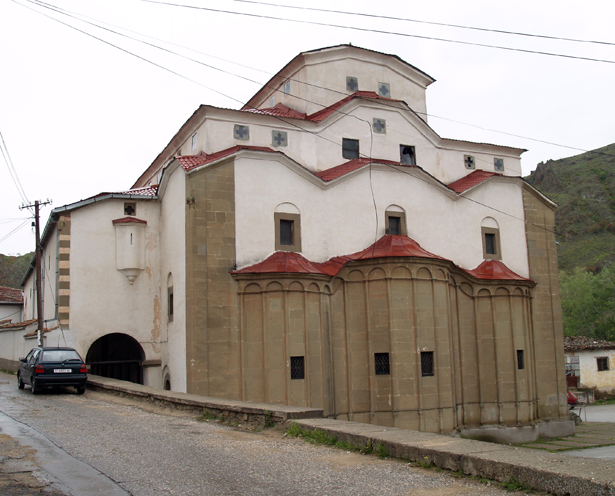
The Church “Uspenie na Sv. Bogorodica” in Novo Selo, Shtip, is one of the finest and most inventive sacred buildings of this period in the city of Shtip and in Eastern Macedonia. It was built on the site of an older church, also dedicated to “Uspenie na Sv. Bogorodica,” dating from 1808–1809. An inscription carved above the southern entrance door states that the church was renovated in 1850. This inscription suggests that the construction/renovation began in 1835–1836 and that the church was built with voluntarily collected financial resources from the citizens of Shtip, at a time when Macedonia was still under Ottoman rule.
The church was built by the talented master builder Andrej Damjanov (1800–1878) and his craft team. His brothers Nikola, Gjorgji, and Kosta Damjanov also played a special role in decorating the church interior.
In plan, the church is designed as a three-aisled basilica, surrounded by porches on the western, northern, and southern sides, which on the upper level continue as a gallery. The central nave is emphasized and covered by four domes supported on pendentives. On the eastern side, the church ends with three polygonal apses.
The interior is richly adorned with sculpted decoration—medallions combined with vegetal and zoomorphic motifs. The overall carved/woodcarved decoration is the work of Nikola Damjanov, who produced the large iconostasis, the bishop’s throne, and the church doors.
The interior is richly adorned with sculpted decoration—medallions combined with vegetal and zoomorphic motifs. The overall carved/woodcarved decoration is the work of Nikola Damjanov, who produced the large iconostasis, the bishop’s throne, and the church doors.
In 1972, a permanent icon gallery was established on the upper level of the church, with a rich collection of icons by many known and unknown painters, created from the late 16th–17th centuries to the beginning of the 20th century, as well as manuscripts and printed books, church relics, and other materials. In the courtyard, on the western side of the church, in the period when the church was built, the residential quarters were also constructed.
Constituent Parts of the Cultural Property
Decisions on declaring a Cultural Monument (collections)
-
Collection of icons from the small iconostases in the southern and northern chapel, Decision No. 1001-73 of 24.04.1999, by the Institute for the Protection of Cultural Monuments and Museum, Shtip.
Appendix: copies of the list attached to the Decision. -
Collection of icons from the iconostasis of the church “Uspenie na Sv. Bogorodica”, Decision No. 1001-72 of 24.04.1990, by the Institute for the Protection of Cultural Monuments and Museum, Shtip.
Prologue: copies of the Solution list.
Individual items (decisions)
-
Icon “St. Petka and St. Nedela”, Decision No. 1001-126 of 16.09.1998, IPCHM, inventory number SK 66.
-
Icon “Lamentation of Christ”, Decision No. 1001-125 of 16.09.1998, IPCHM, inventory number SK 17839.
-
Phelonion (vestment), Decision No. 1001-124 of 16.09.1998, IPCHM, inventory number SK 66.
-
Icon “The Wonderworking Icon of the Mother of God Skoropomoshchnitsa”, Decision No. 1001-123 of 16.09.1998, inventory number SK 66.
-
Large gilded cross, Decision No. 1001-122 of 16.09.1998, inventory number SK 66.
-
Icon “Jesus Christ – Great Archpriest”, Decision No. 1001-121 of 16.09.1998, inventory number 1806.
-
Large baldachin (canopy), Decision No. 1001-120 of 16.09.1998, inventory number SK 66.
-
Manuscript book – Holy Gospel, Decision No. 1001-70 of 24.04.1999, inventory number 1374.
-
Manuscript book with apocryphal texts, Decision No. 1001-69 of 24.04.1999, inventory number 1373.
In 1970, a project was prepared to repurpose the upper floor of the church into a Permanent Icon Gallery and to cover it with salonite slabs, prepared by the Republic Institute for the Protection of Cultural Monuments.